Monkey Age Calculator - Know Monkey Age in Human Years
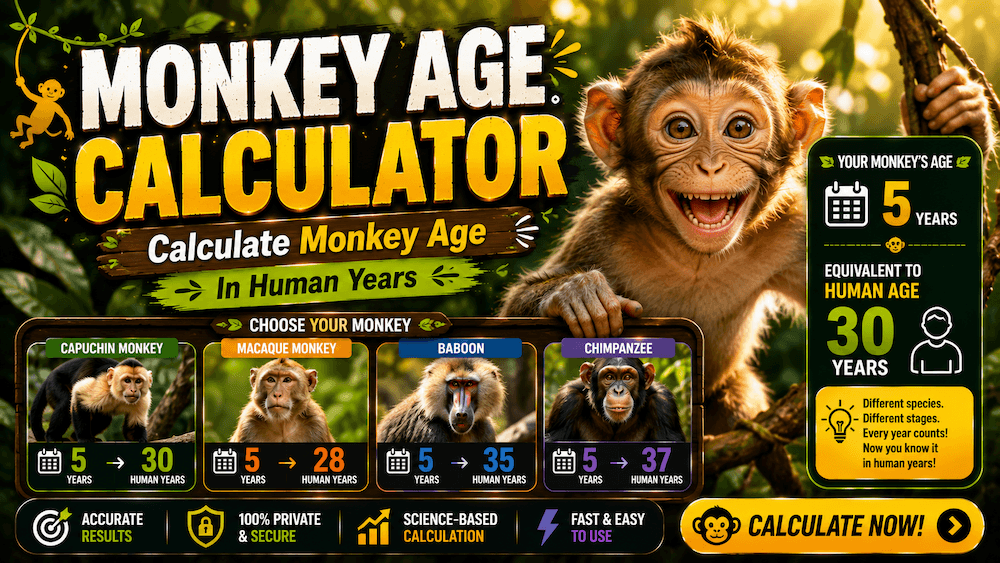
Monkey Age Calculator is an age calculator tool that helps you estimate a monkey’s age in human years. This tool is designed to help users understand monkeys better by comparing their age and life stages with humans.
You can calculate a monkey’s age either by entering its date of birth or by entering its current age. The calculator converts the result into human-equivalent years to make understanding easier.
By comparing monkey age to human age, you can better understand their growth, behavior, and stage of life. This can help you learn more about monkeys and understand them in a more familiar way.
How to Use Monkey Age Calculator
Using this calculator is simple.
First, find the Monkey Age field and enter your monkey’s age.
For example:
- 5 years
- 6 years
Below that, you will see the Monkey Name field. This is optional, so you can enter a name or leave it empty.
Next, select the Age Unit.
Choose whether the age you entered is in:
- Years
- Months
For example, if you entered 5 and selected Years, the calculator will treat it as 5 years old.
After that, choose the monkey’s species.
Available species include:
- Spider Monkey
- Baboon
- Marmoset
- Tamarin
Select the species that matches your monkey and then click "Calculate Monkey Age".
Once calculated, you will see your monkey’s profile and information such as:
- Current age
- Life stage
- Human-equivalent age
- Life insights
You may also see estimated lifetime statistics, including:
- Heartbeats
- Breaths taken
- Hours slept
- Food consumed
- Water consumed
- Distance traveled
- Additional life statistics
The tool may also show fun facts about monkeys to help you learn and understand them better.
How Do Monkeys Age?
Unlike dogs or cats, there is no one rule for how monkeys age. The word "monkey" includes many different kinds of monkeys from around the world, and each type grows and ages at a different speed.
To compare a monkey’s age to human years, we need to know what kind of monkey it is and how long that species usually lives.
Monkeys Grow Up Fast
Most monkeys grow up much faster than humans.
Humans usually become adults around 18 years old, but many monkeys become adults much earlier.
- Small monkeys like Marmosets become adults in less than 2 years.
- Bigger monkeys like Macaques and Capuchins usually become adults in about 4 to 5 years.
Growing up quickly helps monkeys survive and have babies earlier in life.
| Monkey Age | Human Age (Marmoset) | Human Age (Capuchin) |
|---|---|---|
| 1 Year | 7 Years | 4 Years |
| 5 Years | 35 Years | 20 Years |
| 10 Years | 70 Years | 29 Years |
| 20 Years | 140 Years | 47 Years |
| 30 Years | - | 65 Years |
Many Monkeys Can Live a Long Time
After becoming adults, monkeys usually age more slowly and many can live for many years.
-
Marmosets and Tamarins:
These are small monkeys and usually live about 12 to 16 years. -
Macaques and Baboons:
These monkeys live longer and can reach about 25 to 35 years. -
Capuchins and Spider Monkeys:
These monkeys are very smart and can live a very long time. With good care, they may live 40 to 50 years.